Monday, 5 March 2012

Mukachevo castle.

If You'll decide to visit Ukraine, I highly recommend You to go in the beautiful Transcarpathian city Mukachevo and, of course, to visit wonderful Mukachevo castle, famous city's sightseeing, constructed in the XIV-XVII centuries. Mukachevo castle is situated on the mountain 68 m high and occupies an area of 14 thousand sq. km. The castle consists of three parts, situated on the three different terraces. Upper Mukachevo castle, the oldest castle's part of the XIV-XVI centuries, locates on the mountain's top and is former residence of castle's owners. Upper castle has closed yard, two-storey and three-storey buildings of the XVI-XVII centuries, where castle's owners lived, chapel of the XVII century and three round towers of the XIV-XVII centuries. Well 85 m deep is in the yard and two bastions are in the north side of Upper castle. Middle Mukachevo castle of the XVII century locates 6m lower than Upper and has four bastions. Big yard of Middle castle is surrounded by two-storey and three-storey buildings - former arsenal, knightly hall, garrison's barracks, kitchens, pantries. Lower Mukachevo castle, constructed also in the XVII century, locates 10 m lower than Middle. Two orbed bastions are nearby the gate of Lower castle. In general there are eight bastions in the whole castle and the artillery was in the bastions in the past. Mukachevo castle is surrounded by wall 3 m thick and a moat 10-12 m deep. Many years ago, in the XVI century, a water moat surrounded Mukachevo castle and the wooden palisade, called "Palanok", was built around this water moat to strengthen it. Though water moat and wooden palisade don't exist nowadays, but Mukachevo castle got the second name - "Palanok".


So welcome to "Palanok", Mukachevo castle!

Sunday, 26 February 2012

Yosyf Slipyy

In the last two weeks it was marked the 120th anniversary since the birth of Yosyf Slipyy, Patriarch, Great Archbishop and Cardinal of Ukrainian Greek Catholic Church, in Ukrainian cities and abroad.
Yosyf Slipyy was born on February 17th, 1892 in the village Zazdrist in Ternopil region. At first Y. Slipyy finished school in his native village and then Ternopil gimnasium in 1911. Since 1911 he studied in Lviv Greek Catholic Seminary and since 1912 - in Innsbruk University. On September 30th, 1917 Yosyf Slipyy was ordained as a priest by Metropolitan of Ukrainian Greek Catholic Church Andrey Sheptytskyy in Univ, Lviv region. Y. Slipyy got a doctorate in theology at Innsbruk University in 1918 and continued studying in Rome at the Pontifical Oriental Institute and at the Pontifical Gregorian University in 1920. Y. Slipyy got Master Agregatus at the Pontifical Gregorian University and became a professor of the dogmatic theology. In 1922 he came back in Lviv and teached dogmatic science in Lviv Greek Catholic Seminary, where became a rector in 1926. Yosyf Slipyy was co-founder of Theological Scientific Society in Lviv and editor of the journal "Theology" in 1922-1939. In 1928 Metropolitan Andrey Sheptytskyy reformed Lviv Greek Catholic Seminary into Lviv Theological Academy and Yosyf Slipyy was appointed Academy's rector in 1929. On December 22th, 1939 Metropolitan A. Sheptytskyy ordained Y. Slipyy as Archbishop with the rights of successor of Ukrainian Greek Catholic Church's Head. Yosyf Slipyy became Head of Ukrainian Greek Catholic Church after Andrey Sheptytskyy's death on November 1th, 1944.

Memorable table, dedicated to Yosyf Slipyy on Kopernyk Street in Lviv.

On April 11th, 1945 Metropolitan Yosyf Slipyy was arrested by NKVS in Lviv and was convicted to 8 years of servitude and hard labour in Siberia. Soviet power wanted to destroy Ukrainian Greek Catholic Church and sent Ukrainian Greek Catholic Church's priests in the prisons since 1945. Ukrainian Greek Catholic Church (UGCC) was officially prohibited from 1946 util 1989 in USSR, and Greek Catholic Ukrainians went secretly in some houses, where UGCC secret ordained priests conducted liturgy, married couples, baptized children till 1989.
In 1953 Soviet power continued Yosyf Slipyy's conviction until 1957, and then convicted him again for servitude until 1962. Soviet power decided to continue a term of Slipyy' servitude at the fourth time, but thanks to great efforts of Pope John XXIII Yosyf Slipyy was freed in 1963. After 18 years of Siberian servitude and staying in the prisons Yosyf Slipyy arrived in Grottaferrata monastery in Italy in 1963 and then lived in Rome.
Pope Paul VI proclaimed Yosyf Slipyy Cardinal of Catholic Church on January 25th in 1965. Cardinal Yosyf Slipyy did very much for Ukrainian Greek Catholic Church. In Rome he constructed St. Sofiya Greek Catholic Cathedral, founded Ukrainian Catholic University of St. Pope Klyment and male monastery of Studyty order, reconstructed Sts. Serhiy and Vakkh Greek Catholic Church and created Museum of Ukrainian Art nearby this church. Cardinal Yosyf Slipyy united Ukrainian episcopate in Synod of Ukrainian Church, helped to make translated liturgy's books from different languages into Ukrainian, visited Ukrainians around the world to unite them. Yosyf Slipyy hoped for USSR's destruction and for creation of Ukrainian independent state at least. He also wished to be buried near Metropolitan Andrey Sheptytskyy in Lviv, Ukraine.
Great Archbishop, Patriarch, Cardinal of Ukrainian Greek Catholic Church died on September 7th, 1984 in Rome and in 1992 his remains were transported and buried in the crypt of St. Yuriy Greek Catholic Cathedral in Lviv near Metropolitan Andrey Sheptytskyy's remains.
Yosyf Slipyy was strong person and religious leader of Ukrainian nation, who didn't fear Stalin, repressions, Siberian servitude, who wanted Ukrainian independence, patriarchate of Ukrainian Greek Catholic Church and all good things for Ukrainian people.


Monument to Yosyf Slipyy in Ternopil.

Friday, 17 February 2012

New Minister of Defence

New allocation on the post of Minister of Defence shocked citizens of Ukraine. On February 8th, 2012 President Viktor Yanukovych allocated on this post deputy of "Party of the Regions" Dmytro Salamatin, famous as one of so called deputies-fighters which often take part in the parliament's fights. Thus on April 27th, 2010 when opposition tried to stop the ratification of Kharkiv agreements (which allowed Russian navy to locate in the Crimea till 2042) by the parliament and blocked the parliament's rostrum, then some powerful deputies began to beat oppositional deputies and deputy Dmytro Salamatin hurted a nose of oppositional deputy Volodymyr Karpuk from the party block "Our Ukraine-Our Defence". Later in August, 2010 Dmytro Salamatin, who was also a director of state firm "Ukrspezexport" ("Ukrainian special export"), beat with a chair the director of "Termokholod" ("Thermocoldness") Yuriy Kyselov in his office, because the offices of "Ukrspezexport" and "Termokholod" were situated in one building and Dmytro Salamatin wanted to evict Kyselov's firm, but court let "Termokholod" to stay in that office. So D. Salamatin was angry from such court's decision and beat the opponent. And on December 16th, 2010 when oppositional deputies blocked the entrances into session hall of the parliament and demanded to abolish Yulia Tymoshenko's travel ban, powerful deputies broke the entrances' doors and began to fight oppositional deputies and deputy Dmytro Salamatin hurted a hand of deputy Volodymyr Bondarenko from "BYUT" in this fight. And such deputy-fighter D. Salamatin will rule Ukrainian army. He's not military man and more - he was born in Kazakhstan and lived in Russia till 1999 and only after 1999 in Ukraine. And now he is Minister of Defence of Ukraine.

Sunday, 5 February 2012

Ukrainian biathlonists

Oops...I didn't retell You about important victories of Ukrainian sportsmen. So I'll do it right now. From January 26th until February 2nd IBU Open European Championships Biathlon were held in Osrblie, Slovakia and Ukrainian biathlonists consolved Ukrainian fans very much: Ukrainian adult team won 3 gold and 5 silver medals and Ukrainian junior team won 1 gold, 1 silver and 1 bronze medals. Ukrainians can be really proud of Ukraine's biathlonists! Olena Pidhrushna won 2 gold medal in women's sprint and pursuit competitions and Iryna Varvynets won gold medal in women's junior pursuit competition. Our women's adult team (Yuliya Dzhyma, sisters Valentyna and Vita Semerenko, Olena Pidhrushna) also won gold medal in women's relay. Silver medals were brought for Ukraine by Artem Pryma in men's sprint and individual competitions, Valentyna Semerenko in women's sprint and pursuit competitions, Serhiy Semenov in men's pursuit competition, Iryna Varvynets in women's junior sprint competition. And Ukrainian junior biathlonists (Anastasiya Merkushyna, Iryna Varvynets, Ivan Moravskyy, Oleksandr Dakhno) won bronze medal in mixed relay. Biathlon is popular kind of sport in Ukraine and Ukrainians sincerily congratulate Ukraine's biathlonists with their victories and wish them good luck and many victories at the future world biathlon championship in Ruhpolding, Germany.

Friday, 3 February 2012

Huge transport problems in Lviv

Since the first day of 2012 and nowadays Lviv has big transport problems. The reason of these problems is new transport scheme of the routes of small buses, called marshrutky in Ukraine. New transport scheme was adopted in the end of 2011 by Lviv municipality to change transport routes in the better way. But indeed Lviv power just changed enterpreneurs-proprietors of licenses for new transport routes and diminished the proprietors to 5! And the quantity of small buses diminished too, because these enterpreneurs-winners have such quantity of transport as they had in the past. Lviv power said about the necessary to lessen transport in the historical centre of the city, that's why our power decided to change transport scheme, but power didn't think anything about citizens! In January of 2012 and nowadays Lviv citizens stay on the transport stations for 30-40 minutes and even more an hour, waiting for any transport: buses, marshrutky, trolley-buses, trams. It's hard to wait transport, especially in these frosty days, when Lviv day temperature lowers to -18 degrees by Celcius. Of course, it's not Siberian temperature, but here is high humidity of the air in Lviv, so that's why even Lviv's -18 degrees are bad for human health.
So people wait for transport much longer than earlier, and they often take a taxi in the morning not to be late for lectures in the institute or for work and not to be discharged. Many people go on foot for work or for study, though they can be much frozen now. And such transport collapse lasts more than a month in Lviv. Lviv citizens want only one thing in this situation - they want to turn the old transport scheme in the city! But for the present Lviv power doesn't hear what citizens ask.

Cold winter in Ukraine

Today it's known cold wintry weather killed 101 persons - 64 people died on the streets, 11 in the hospitals and 26 in their own homes since January, 27th in Ukraine. The winter's victims got frostbitten and died, the majority of the frost's victims were homeless people. During last frosty days 1592 Ukrainians appealed to doctors for help because of hypothermia and frostbite and1248 of them were hospitalized. There were created thousands special places around the country, where people could warm. Meteorologists say the temperature will continue to lower in the next days in Ukraine.

Tuesday, 31 January 2012

The first exhibition of the sculptures made of ice in Lviv

Creation of the sculptures made of ice was held in Lviv at first and here are my photos of the exhibition of these ice sculptures.


Monday, 30 January 2012

Battle near Kruty

Yesterday, on January 29th, Ukrainians commemorated young Ukrainian fighters, killed in the battle with Soviet troops near railway station Kruty (Chernihiv region, 130 km from Kyiv) on January 29th, 1918. There were only 300 (some scientists say 420 or 500) Ukrainian young men - schoolchildren, grammar-school boys, students against 4500 (some historians say 5000 or 6000) Soviet soldiers in the battle near Kruty. That battle lasted more than 5 hours. Soviet troops won and almost all Ukrainians protectors were killed in this battle near Kruty. Indeed that Ukrainian youth understood a great danger for their lives in the battle and knew how many troops were in their enemy. But these Ukrainian fighters went and fought to save their land from Russian occupants. But they died. Because it was a few quantity of the protectors from the enemy. Nowadays Ukraine and especially Ukraine's youth commemorates the events of the battle near Kruty every year. Because this battle is a symbol of patriotism, devotion for homeland, readiness to fight and to die for native land. And also battle near Kruty teachs us that a little quantity of the protectors can't protect motherland against troops of the occupants, so it must be many protectors in the battle.

Monday, 16 January 2012

Kamyanets-Podilskyy fortress


It's snowy and wintry weather in Lviv. I like such weather very much. But...You know what? I remembered my beautiful trip to Kamyanets-Podilskyy in spring in 2009 and I noticed that I didn't show You any photos from this nice city in Khmelnytskyy region. It's my mistake, sorry. Because if You want to travel in Ukraine, You just must to visit that amazing city-museum and its ancient fortress, which foundation dates to the XII-XIIth centuries and its towers were mainly built in the XIV-XVth centuries.
Wonderful view of Kamyanets-Podilskyy fortress!

The graceful towers of the XVIth century Lyantskoronsk's Tower and Rozhanka Tower and small towers New Commandant's Tower and Commandant's Tower (from left to right).

Wooden gallery between towers

And this is just a historical photo. Here You can see Pope's Tower, the biggest tower of the fortress, which was particulary ruined in august of 2011 because of huge rains and wind.
Pope Yuliy II gave money to finish a building of the tower in the early of the XVIth century, that's why tower is named Pope's. And another name of that tower is Karmalyuk's Tower. Ustym Karmуlyuk was Ukrainian rebel in the first half of the XIXth century and he was jailed in this tower in 1818-1823.

Very different towers (from left to right): Tenchynsk's Tower of Krakiv type, White or Lask's Tower and Day Tower. Tenchynsk's Tower is named after Yan Tenchynskyy, one of the authors of the plan of a fortress' fortifications. It's known that fortress' kitchen situated in White Tower and St. Mykhayil Catholic Chapel was in Day Tower in the XVIth century.

The ancientest tower of the fortress is called Day Tower and it's without roof. The ruins of its foundation date to the XII-XIIIth centuries.

I think this window was special - specially for cannon, yeh?

Aha, such were triangular windows in the Middle Ages!

One of the grated windows of the fortress and view of New Commandant's Tower, reconstructed thanks to archive's pictures and documents in 2007-2008.

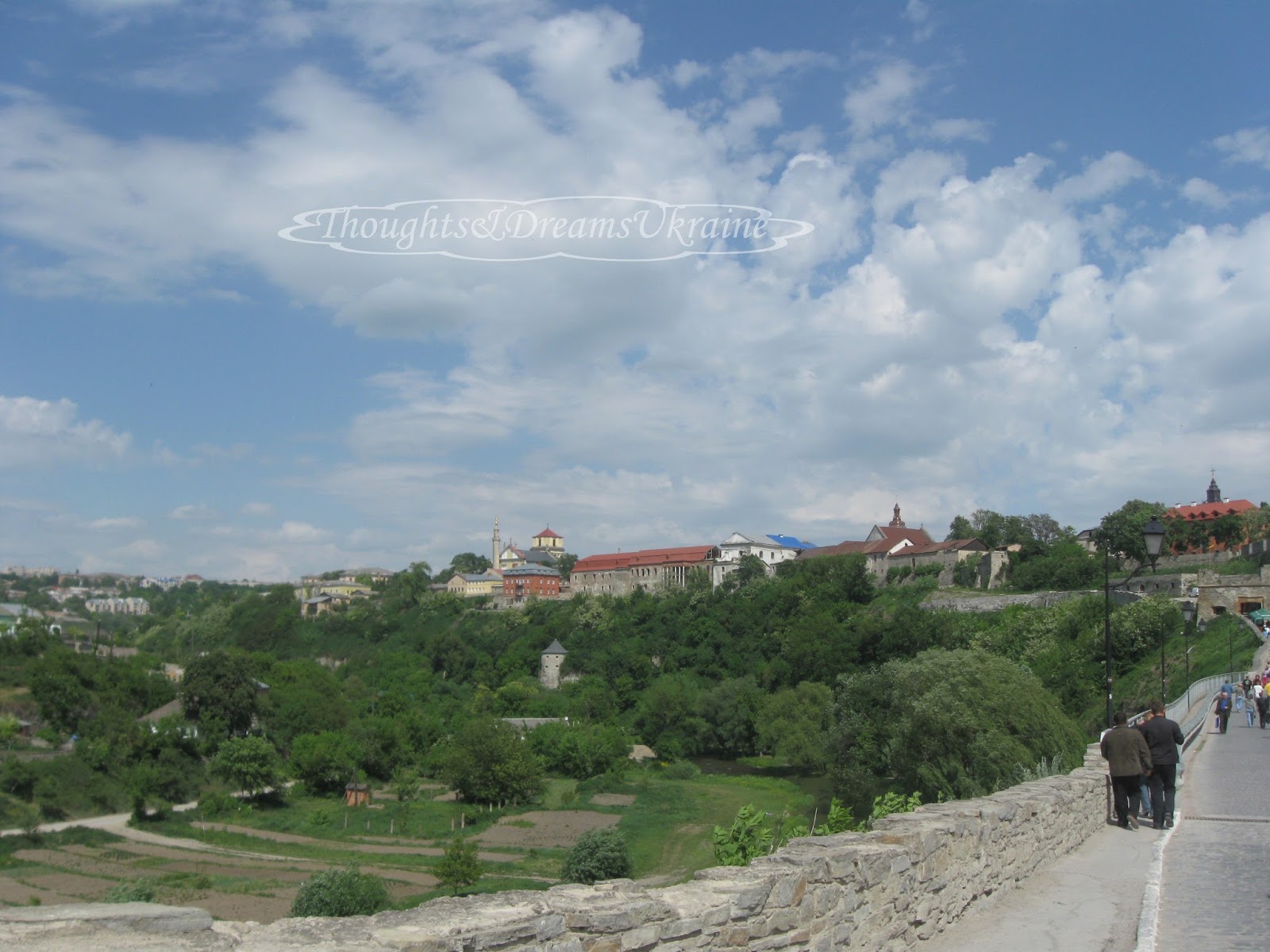
View of Kamyanets-Podilskyy city from mediaval fortress' windows.


Part of the fortification's wall of bastion type of the XVIIth century around the fortress.

Fortress' jail, situated in the cellar.

 
Kamyanets-Podilskyy city

Welcome to see the great fortress in Kamyanets-Podilskyy in Khmelnytskyy region!

Sunday, 1 January 2012

Happy New 2012 Year!

Wish You wonderful and successful new 2012 year! That dreams come true and happiness, love, peace, good be in Your life! Wish You to be happy, healthy and in harmony with yourself. Let 2012 year present You only amazing surprises.